Federal Budget 2026-27: Business Analysis
Overview
The 2026-27 Federal Budget sought to strike a balance between cost-of-living relief for households and the urgent need for economic reform to raise productivity.
Against the backdrop of rising inflation and declining GDP growth, a $28.3 billion deficit is expected for 2025-26.
The Budget points to deficits out to FY2034-35 despite a cumulative $44.9 billion improvement in the bottom line over the next four years, courtesy of higher tax revenues and net savings of $26.1 billion.
The volatile global outlook adds to pressure and uncertainty, which is compounding domestic challenges and eroding business conditions and confidence.
There are positives for business in this Budget, but much remains to be done. Business NSW continues to call on Government to raise its ambitions for reform, and to continue to engage with the business community.
Key measures for business
- Capital Gains Tax: From 1 July 2027 the existing 50% CGT discount will be replaced by a system which taxes real gains at a minimum 30% tax rate. This will apply to capital gains derived from most asset classes including property, shares and business profits. There are exemptions for new builds, the family home, and affordable housing. The Government will consult with the startup sector on likely impacts.
- Discretionary trusts: From 1 July 2028, a minimum 30% tax rate will apply to distributions from discretionary trusts to family members. There will be a three-year transition period allowing for the wind up and transition of trusts to new ownership structures.
- Instant asset write-off made permanent: The temporary $20,000 instant asset write-off for small businesses will be made a permanent feature of the tax system, effective from 1 July 2026.
- Free access to Australian Standards: Businesses will no longer pay up to $1,600 to access mandatory Australian Standards for construction, occupational health and safety, and product safety.
- Fuel Security and resilience: Up to $11.9 billion for a National Fuel Security Plan to strengthen Australia’s fuel, freight and supply chain resilience. This includes $7.5 billion for a new Fuel and Fertiliser Security Facility, a $3.2 billion Australian Fuel Security Reserve and a $1 billion Economic Resilience Program to support critical supply chains.
- Establishing a Domestic Gas Reservation: $35.5 million to support gas market reliability and energy security, including establishing a new Domestic Gas Reservation Mechanism. From 1 July 2027, the scheme will reserve the equivalent of 20 per cent of gas exports for the domestic market while also streamlining offshore gas approvals to support new supply.
- Enabling infrastructure for housing developments: A new $2 billion Local Infrastructure Fund to help local governments and state utilities build essential infrastructure to support new housing including by connecting essential services such as water, power, sewerage and roads. This funding aims to unlock delivery of 65,000 homes over the decade.
Fiscal and economic outlook
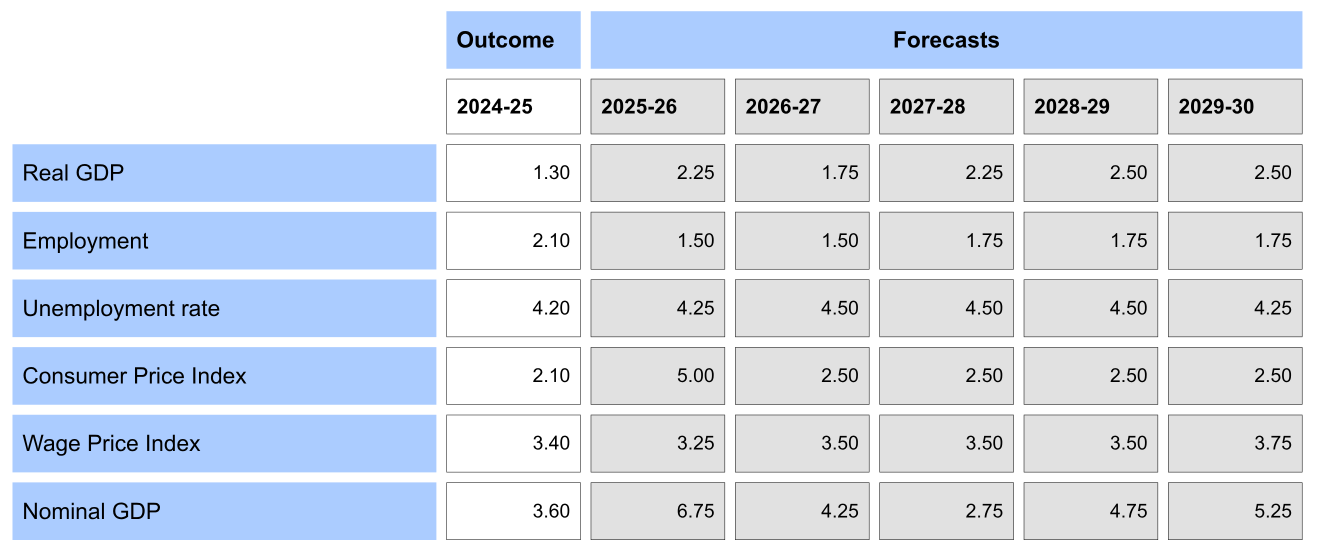
- Economic growth: The Australian economy is expected to grow by a smaller than expected 1.3% in 2025-26, slower than last year’s 1.4%. Forecasted GDP growth is expected to remain below previous forecasts but rise to 2.5% in 2028-29, below previous budget forecasts of 2.75%.
- Inflation: CPI growth is expected to increase to 5% by the end of 2025-26, significantly exceeding previous forecasts of 3% and placing pressure on businesses and consumers. Inflation is forecast to return towards the Reserve Bank of Australia’s target band to 2.5% in 2026-27, in line with previous forecasts. Forecasts assume that global oil prices will begin to decline throughout 2026.
- Employment: Employment growth is expected to moderate across the next 5 years from 2.1% to an average of 1.65%. The unemployment rate is expected to rise modestly from 4.2% to 4.5% in 2026-27 before returning to 4.25% in 2029-30.
- Wage growth: Real wages are expected to slide in 2025-26 before growing consistently through the forecast period of 2026-27 to 2029-30, with the wage price index projected to increase annually by at least 3.5% over that time.
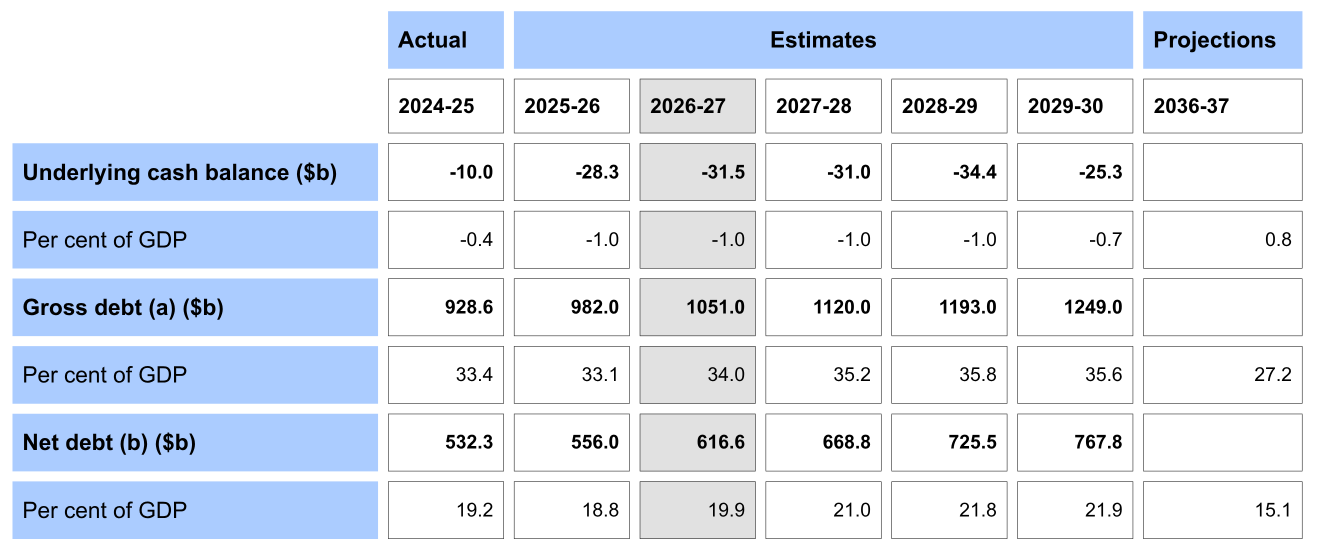
- Budget deficit: Despite finding savings and reprioritisations of $63.8 billion, the Government is expecting a deficit of $28.3 billion in 2025-26, peaking at $34.4 billion in 2028-29 before an eventual return to balance by 2034-35.
- Net debt: Net debt is forecast to increase from $532.3 billion (19.2% of GDP) in 2024-25 to $556 billion (18.8% of GDP) in 2025-26 and $616.6 billion (19.9% of GDP) in 2026-27.
Table 1: Budget aggregates
Note:
a) Gross debt measures the face value of Australian Government Securities (AGS) on issue as at the end of the financial year.
b) Net debt is the sum of interest bearing liabilities (which includes AGS on issue measured at market value) less the sum of selected financial assets (cash and deposits, advances paid and investments, loans and placements) as at the end of the financial year.
Source: Budget Paper No.1 - Budget 2026-27 (Table 1.2)
Table 2: Economic forecasts
Note:
a) real GDP and nominal GDP are percentage change on preceding year. Employment, the consumer price index and the wage price indedx are through-the-year growth to the June quarter. The unemployment rate is the rate for the June quarter.
Source: Budget Paper No.1 - Budget 2026-27 (Table 1.1)
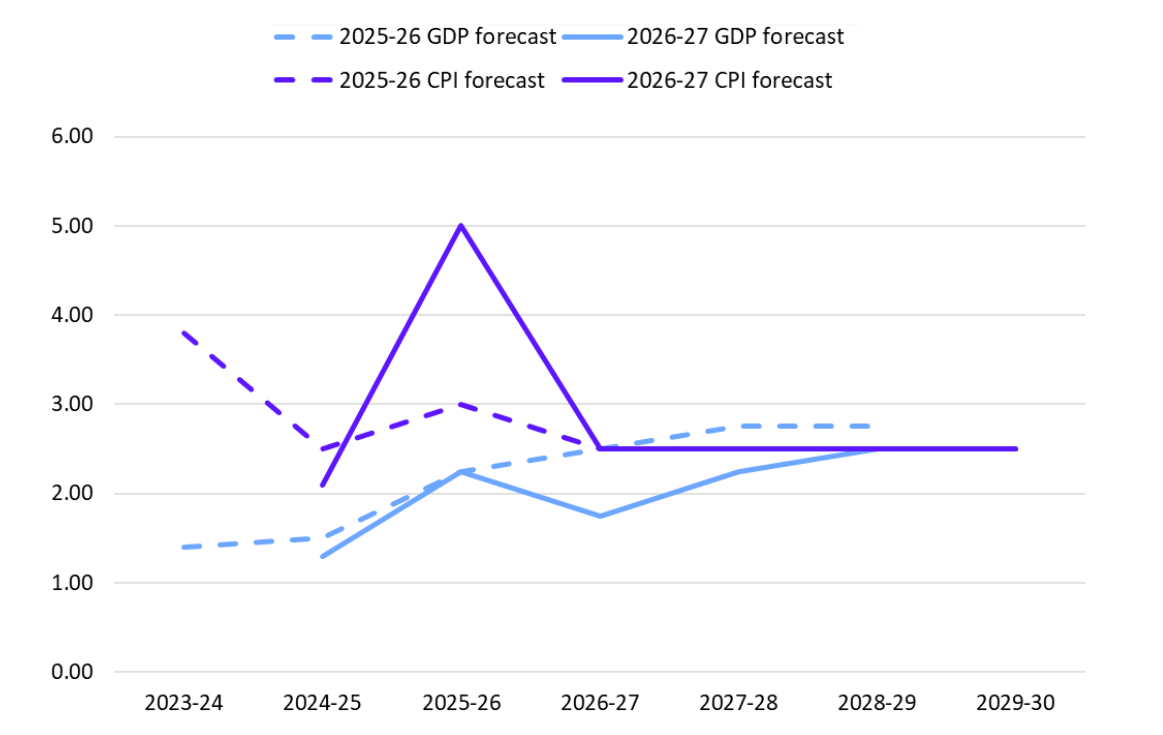
The 2026-27 Federal Budget forecasts a deterioration in economic growth and an increase in inflation relative to the 2025-26 Federal Budget. Inflation in 2025-26 is likely to be two percentage points higher than expected, before returning to trend. Economic growth in 2026-27 is likely to be 0.75 percent lower than expected and remain on a lower trajectory.
Figure 1: How GDP and CPI forecasts have changed since the 2025 Budget
Highlights for business
Tax and productivity
- Capital Gains Tax: From 1 July 2027 the existing 50% CGT discount will be replaced by a system which taxes real gains at a minimum 30% tax rate. This will apply to capital gains derived from most asset classes including property, shares and business equity. There are exemptions for new builds, the family home, and affordable housing. The Government will consult with the start up sector on likely impacts.
- Negative gearing: Negative gearing will be limited to new homes, applying to all properties purchased from 12 May 2026. Existing investment properties are exempt. Alongside CGT reform, this change is intended to help an extra 75,000 first home buyers enter the property market over the next decade.
- Discretionary trusts: From 1 July 2028, a minimum 30% tax rate on distributions from discretionary trusts to family members, expected to raise $4.5 billion over the next four years. There will be a three-year transition period allowing for the wind up and transition of trusts to new ownership structures, such as a company.
- Reforming the treatment of tax losses: From 1 July 2026, businesses with turnover below $1 billion will be able to carry back a tax loss and offset it against tax paid over the past two years, helping to smooth out volatile business results. The change is expected to decrease receipts by $2.3 billion and increase payments by $468 million over the five years from 2025-26.
- Tax loss refundability for startups: From 1 July 2028, startups with annual turnover below $10 million that generate a tax loss in their first two years of operation will be able to generate a refundable tax offset against the loss, supporting cashflow.
- Boosting Productivity – Better Regulation: The government will provide $198.1 million over two years from 2026-27 to boost productivity through streamlining regulatory systems and secure access to data.
Support for Small Business
- Instant asset write-off made permanent: The temporary $20,000 instant asset write-off for small businesses will be made a permanent feature of the tax system, effective from 1 July 2026.
- Free access to Australian Standards: Businesses will no longer pay up to $1,600 to access mandatory Australian Standards for construction, occupational health and safety, and product safety.
- Personal support for small business owners: $8.2 million over three years from 2025–26 to extend the Small Business Debt Helpline financial counselling program and the New Access for Small Business Owners mental health coaching program to 30 June 2027.
- Workplace Relations additional support: $11.2 million over 2 years to progress its workplace relations agenda, including $4.6 million to provide targeted assistance to fast track accreditation of residential builders under the Work Health and Safety Accreditation scheme.
Cost-of-living relief
- $1,000 instant tax deduction: Workers will be able to reduce their taxable income by up to $1,000 without providing receipts with their tax return, from July 2027 onwards. The average worker is expected to save $205.
- Working Australians Tax Offset: From 2027-28 a $250 annual tax offset for income derived from work. This raises the effective tax-free threshold by nearly $1,800.
- Securing more housing for at-risk Australians: $59 million over four years from 2026-27 to supplement rental income for Community Housing Providers providing social housing for over 4,000 young people who are at risk of, or experiencing, homelessness.
Energy and Fuel Security
- Australian Fuel Security and Resilience package: Up to $11.9 billion will be provided for a National Fuel Security Plan to strengthen Australia’s fuel, freight and supply chain resilience. Key measures include up to $7.5 billion for a new Fuel and Fertiliser Security Facility, a $3.2 billion Australian Fuel Security Reserve and a $1 billion Economic Resilience Program to support critical supply chains. The package also includes funding for freight resilience, fuel system oversight and cleaner transport infrastructure.
- Establishing a Domestic Gas Reservation: The Government will provide $35.5 million to support gas market reliability and energy security, including establishing a new Domestic Gas Reservation Mechanism. From 1 July 2027, the scheme will reserve the equivalent of 20 per cent of gas exports for the domestic market while also streamlining offshore gas approvals to support new supply.
- Maximising consumer and community benefits of the energy transition: $143.2 million committed to implement the National Consumer Energy Resources Roadmap, strengthening the role of the Australian Energy Regulator, expanding national vehicle electrification initiatives and maintaining proportionate battery safety inspections under the Cheaper Home Batteries program.
- FBT exemption changes for electric vehicles: Incentives for the shift to electric vehicles will be maintained with transitional measures being put into place resulting in a permanent 25 per cent discount on fringe benefits tax (FBT) from 1 April 2029.
Infrastructure, transport and environment
- Enabling infrastructure for housing developments: A new $2 billion Local Infrastructure Fund to help local governments and state utilities build essential infrastructure to support new housing including by connecting essential services such as water, power, sewerage and roads. This funding aims to unlock delivery of 65,000 homes over the decade.
- Inland Rail: The Inland Rail route will be curtailed at Parkes, no longer extending through northern NSW into Queensland. The rail corridor will be preserved, and $1.8 billion of the savings will be reallocated to other rail projects.
- High Speed Rail development works: A further $659 million over the next three years to continue progress on the Newcastle to Sydney High Speed Rail project.
- Sydney to Canberra rail upgrades: $50 million in priority upgrades to the 321-kilometre rail infrastructure between Sydney and Canberra benefiting the Southern Tablelands and Goulburn region.
- Supporting aviation priorities: $731 million for aviation priorities over the next four years, including a $600 million investment in Airservices Australia and $14.3 million funding to support cargo and regulatory operations at Western Sydney International Airport.
- M1 safety improvements: As part of the new Infrastructure Investment Program, $45.0 million for M1 Safety Improvements in New South Wales.
- Supporting Water Reforms: $21.1 million over four years from 2026–27 (and $1.5 million per year ongoing) to continue water reform activities including supporting the transparency, integrity and understanding of water markets, deliver key reforms and work with affected communities on the Murray‑Darling Basin (Basin) Plan.
- Implementing environmental reforms: Over $300 million in funding to implement significant environmental reforms to the EPBC Act including the establishment of the new National Environmental Protection Agency.
- Supporting circular economy: Additional funding of $17 million in 2026–27 to continue delivery of the Government’s circular economy policy, program and legislative functions.
Skills and workforce
- Apprentice incentive funding reprioritisation: Savings of $297.9 million over five years from 2025–26 (and $106.3 million per year ongoing) by redirecting uncommitted funding across programs in the Employment and Workplace Relations portfolio. Savings will be redirected to employer incentives to small and medium employers and Group Training Organisations. Includes changes to the Australian Apprenticeships Priority List methodology and incentive rates from 1 January 2027.
- Scoping for a Teaching and Learning Commission: $5.6 million over two years for exploratory work for a new Teaching and Learning Commission to provide better coordination between curriculum, teaching, assessment, research and reporting practices through integrating agencies.
- Additional measures for improving outcomes in Australian schools: $26.1 million over four years from 2026–27 (and $5.0 million per year ongoing) for a range of measures relevant to improving educational outcomes in schools.
- Migration program changes: The Government will set the 2026–27 permanent Migration Program planning level at 185,000 places and allocate 132,240 places (over 70 per cent) to the Skill stream, prioritising applications from onshore migrants (placing downward pressure on net overseas migration).
- Migration points test overhaul: Changes to the migration points test to select higher‑skilled and younger migrants, and to speed up the process for migrants seeking to have their overseas qualifications recognised.
- Accelerated skills recognition assessments: $85.2 million over four years from 2026–27 to accelerate skills assessments for migrant trades workers, and to accelerate occupational licensing. This includes $75.1 million for a new skills assessment system for Trades Recognition Australia (TRA) to facilitate the integration of occupational licensing and streamline assessment‑to‑licensing pathways for priority trades; and $5.6 million for a new program of skills assessments for onshore visa holders.
Innovation, AI and Digital
- R&D tax incentives: From 1 July 2028 the tax offset for core R&D will increase from 25% to 50% and the cap on claimable expenses will increase from $150 million to $200 million. The threshold to be able to claim R&D expenses will increase from $20,000 to $50,000, a move that potentially threatens R&D in small businesses.
- Expanding venture capital tax incentives: From 1 July 2027, the Government will expand venture capital tax incentives to better facilitate venture capital investment and support early stage and growth businesses, with measures including the increase in various caps.
- AI Accelerator Grants: Up to $70 million for AI Accelerator grants to boost AI development.
- Medical Research Future Fund: $508.5 million to increase disbursements for medical research from the Medical Research Future Fund, from $650.0 million in 2025–26 increasing to $1.0 billion annually from 2030–31.
Support for regional communities
- Regional community infrastructure: $841.7 million over four years from 2026–27 to support economic growth and development across urban and regional Australia. Funding includes: $781.6 million to delivery community infrastructure projects in urban and regional Australia in addition to $30.1 million for round ten of the Stronger Communities Programme.
- Australian Tourism Industry Council’s Quality Tourism Framework: $2 million over two years from 2026–27 to support small and medium businesses in the tourism industry.
- Reforms to the Working Holiday Maker Program: Reforms to reduce barriers, provide fairer allocation and better management of the program.
- Resilience to natural hazards: $6.0 million in 2026–27 to the National Emergency Management Agency (NEMA) to continue engagement with the states and territories on a national high‑speed and high‑capacity mobile broadband emergency response capability.
- Sustaining agricultural export and trade functions: $77.1 million over four years from 2026–27 (and $17.5 million per year ongoing) for the Department of Agriculture, Fisheries and Forestry to sustain agricultural export and trade functions.
Other
- Increasing support for exporters: $39.6 million over three years from 2026–27 to boost the Australian Trade and Investment Commission’s support to Australian businesses, plus $9.2 million over two years from 2026–27 to enhance the Go Global Toolkit online platform which provides information and support to exporters.
- Foreign Affairs and Trade: $33.2 million committed to increase trade opportunities with Indonesia and $25.3 million to expand trade opportunities with India.
- Protecting the tax system against fraud: $86 million over four years from 1 July 2026 and $9.7 million per year ongoing from 2030–31 to deliver Phase 2 of the Counter Fraud Strategy to modernise the prevention and detection of fraud in the tax and super systems.
- Securing critical minerals supply chains: $150 million for selective stockpiling of minerals and $20.4 million to support the operation of the Reserve.
- National Defence Strategy: Additional funding of $6.8 billion over four years from 2026–27 (and $35.6 billion over ten years from 2026–27) to support the delivery of the 2026 National Defence Strategy and Integrated Investment Program to enhance Defence capability, preparedness and resilience.
WHAT’S NEXT – MORE SUPPORT FOR BUSINESS?
On Thursday night at 7.30pm, the Opposition Leader, Angus Taylor, is set to deliver his Budget Reply.
We look forward to all parties engaging with the business community throughout 2026.
Business NSW remains committed to advocating on your behalf in the lead up to this federal election.
For more information from Business NSW, please contact:
Ben Pike, Head of Marketing and Media | ben.pike@businessnsw.com